Kamran Mofid
Gesellschaft | Politik, 21.01.2026
Message to Davos 2026: Time to Rethink Economics
Critical Comment by Kamran Mofid to the State of our Economy
For decades, global leaders have gathered in Davos to talk about progress—yet hunger, inequality, and ecological collapse continue to worsen. In this powerful appeal, Kamran Mofid argues that neoliberal economics has failed humanity and lost its moral compass. He calls for a radical rethinking of economics itself: one that puts ethics, compassion, community, and respect for nature back at its core.
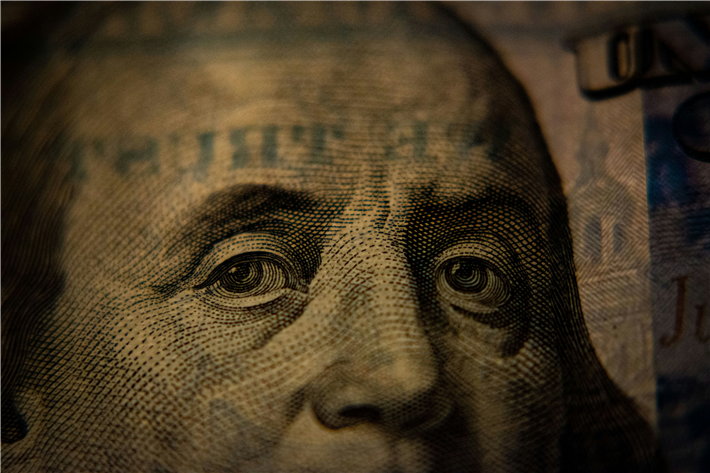
This is a decisive moment in our world history and this is a decisive question for our time: Who and What has Broken the World and Who and What will fix it?
The world and our lives are in a constant state of flux and chaos, because of the dominance of a bankrupt and disgraced economic ideology: Neoliberalism—characterised by deregulation, privatization, marketisation, monetisation, austerity, and free-market fundamentalism, devoid of any human and spiritual values and concerns, resulting in human suffering and environmental degradation.
Time to Rethink
Dear Davos participants, you began your dialogue in 1971 and this is the fruits of your annual dialogue meeting in 2026. Across the world, young and old, black and white, in rich or poor countries, people are going hungry, starving and dying. 100s of millions of your fellow-human beings are starving, homeless, no health care, no medication, no education, no running clean water, no dignity, no hope: Is this right? Do you know what it means to be human? Perhaps a bit less greed on your part, could be a good start?
N.B. This Blog, originally posted in October 2024, under the title of ‘These are what I have learned from 45 years of teaching economics‘ was updated on 19 January 2026, to coincide with the 2026 World Economic Forum in Davos, with its main theme of ‘A Spirit of Dialogue’.
A Better World Needs A Better Economics: We Must Unlearn What We Have Learned About Economics
Dear Davos participants, big and small, powerful and not so powerful, wise and not so wise, visionary and not so insightful, ever since 24 January 1971, you have been dialoguing amongst yourselves, and ever since our world has been falling more and more into catastrophe and man-made disasters. It seems the more you have been meeting, conversing, and pretending to have dialogue, the more our world has fallen to its current nadir of decadence.
Thus, in the interest of saving ourselves and our humanity, time is now for the missing factors in your dialogue: trust, sincerity, spirituality, ethics, and humility, by acknowledging your past mistakes, changing direction and starting fresh, taking action in the interest of the common good.
I suggest, your first dialogue must be under the theme of ‘A Better World Needs A Better Economics’. To start your conversation, I offer you the below. Carpe diem!
These are what I have learned from 45 years of teaching economics:
Lesson No. 1: "The purpose of studying economics is to learn how to avoid being deceived by the economists."-Joan Robinson
She was right. Absolutely. But it took me some time to realise that. Neoliberal Economics: A house of ill repute, Built on a shifting sand. For the sake of humanity, our sanity, and the survival of the entire web of life, it is time to say: 'Goodbye, homo economicus.'
"Was Adam Smith an economist? Was Keynes, Ricardo or Schumpeter? By the standards of today's academic economists, the answer is no. Smith, Ricardo and Keynes produced no mathematical models. Their work lacked the "analytical rigour" and precise deductive logic demanded by modern economics. And none of them ever produced an econometric forecast (although Keynes and Schumpeter were able mathematicians). If any of these giants of economics applied for a university job today, they would be rejected. As for their written work, it would not have a chance of acceptance in the Economic Journal or American Economic Review. The editors, if they felt charitable, might advise Smith and Keynes to try a journal of history or sociology. So what is to be done? There are two options. Either economics has to be abandoned as an academic discipline, becoming a mere appendage to the collection of industrial and social statistics. Or it must undergo an intellectual revolution.”- Anatole Kaletsky, former Chairman of the Institute for New Economic Thinking
One of my favourite scenes from the Star Wars movies is when the young Luke Skywalker is training with Yoda -the legendary Jedi Master- in Episode V, The Empire Strikes Back. In that episode Luke was training in the Force, and he was struggling, finding it very difficult to do his tasks. At one point, he fails to move his ship with the Force, and says it is impossible because it is too heavy. Then, After Yoda moves the ship easily, Yoda turns to Luke and says a line that will be the key in Luke’s training: Luke if you are going to succeed: "You must unlearn what you have learned.”
Lesson No. 2: Not long after gaining my PhD in Economics and starting my full time job as a Senior Lecturer in Economics in the 1980s, I, too, had a ‘Luke Moment’: I must unlearn what I had learned!
More on this later.
Why is modern economics not a force for good and what must be done to make it good? The global financial crisis of 2008, amongst many other shocks and crises before it and since, have shattered the intellectual consensus that had prevailed after the Cold War: That economists know it all best!! They, with their destructive ideological groupthink, spectacularly, failed to see the crash coming, and when it came they had no idea why!!
The Theft of the Century by the Most 'Educated Thieves'- All with MBAs and PhDs! Calling all academic economists: What are you teaching your students?
Goodbye, homo economicus.
The fatal flaw of neoliberalism: it's bad economics
Since then, economists have continuously failed to accurately predict repeated shocks, whilst the modern-day economists are unable to suggest a workable idea or vision to guide humanity towards a sustainable model for global development and prosperity for all. More broadly speaking, there’s a sense that economics as a discipline is in a desperate need of renewal.
Does the profession sufficiently represent the range of people and problems it examines? Is it too far removed from the concerns of ordinary people? Is it really all about the allocation of scarce resources? Is it really all about scarcity and competition? Does it define economic well-being too narrowly? Is it respectful of Mother Nature and our Sacred Earth? Is modern economics a moral, ethical and spiritual discipline?... Is it not the time for different storytellers to tell the story of economics?
Modern Economics: Fibs and Failures and Why I had to Unlearn What I had Learned in Order to Become a Better and more Relevant Economist.
As long as greed, selfishness, individualism, scarcity, extreme competition, rat race, and disregard for Mother Nature (some of the main deadly and sinful fibs of modern economics) are stronger than fairness, equity, justice, trust, abundance, kindness, selflessness, cooperation and community, then, there will always be suffering, pain, amoral behaviour and failures, leading to destruction of life as we know it.
Ethics and other Missing Elements in Modern Economics
To my mind, one of the most destructive sins of modern economics is its blindness and disregard for ethics and morality. But we know that in the golden age of good economics, economics was a branch of ethics. As many scholars of economics and ethics, such as Amartya Sen have noted, 'the role of ethics in today’s mainstream economic theories is peripheral at best. In the prevalent theories of finance, economic agents (including intermediaries such as bankers) act in a morally neutral fashion. Situations with asymmetric information, moral hazard, adverse selection and many other important behavioural concepts, are analysed as incentive problems, while the underlying behaviour is treated as ‘ethically neutral’.
Now let me remind you what modern economics has become to be, an immoral and unethical subject:
‘Sir, Around 1991 I offered the London School of Economics a grant of £1 million to set up a Chair in Business Ethics. John Ashworth, at that time the Director of the LSE, encouraged the idea but had to write to me to say, regretfully, that the faculty had rejected the offer as it saw no correlation between ethics and economics. Quite. Lord Kalms, House of Lords (in a letter to the Times (08/03/2011)
I embarked on studying economics in the mid-1970s for my BA, and MA, completing my studentship in the mid-1980s with the award of my PhD. Then, after years of teaching economics part-time on different seasonal contracts, I started my full-time teaching job with a permanent contract. This was one of the happiest moments in my life: Dr. Kamran Mofid, Senior Lecturer in Economics!
But, gradually, I started to lose all interest, excitement and fulfilment. I thought to myself, what a waste of time! All that struggle, hard work, sacrifices, and all for this, teaching a load of mumbo jumbo, a bit of nonsensical, incomprehensible mathematical/statistical models here and there, with nothing to do with real life and living!
I had two options in front of me: Either to carry on or leave. I decided to carry on, but as a changed economist, trying to become a real economist.
I began the process of transformation by learning that I must unlearn what I had learned whilst studying for my degrees in economics!
This is how I had explained the unlearning of what I had learned elsewhere:
‘From 1980 onwards, for the next twenty years, I taught economics in universities, enthusiastically demonstrating how economic theories provided answers to problems of all sorts. I got quite carried away by the beauty, the sophisticated elegance, of complicated mathematical models and theories. But gradually I started to have an empty feeling.
‘I began to ask fundamental questions of myself. Why did I never talk to my students about compassion, dignity, comradeship, solidarity, happiness, spirituality – about the meaning of life? We never debated the biggest questions. Who are we? Where have we come from? Where are we going?
‘I told them to create wealth, but I did not tell them for what reason. I told them about scarcity and competition, but not about abundance and co-operation. I told them about free trade, but not about fair trade; about GNP – Gross National Product – but not about GNH – Gross National Happiness. I told them about profit maximisation and cost minimisation, about the highest returns to the shareholders, but not about social consciousness, accountability to the community, sustainability and respect for creation and the creator. I did not tell them that, without humanity, economics is a house of cards built on shifting sands.
‘These conflicts caused me much frustration and alienation, leading to heartache and despair. I needed to rediscover myself and real-life economics. After a proud twenty-year or so academic career, I became a student all over again. I would study theology, philosophy and ethics, disciplines nobody had taught me when I was a student of economics and I did not teach my own students when I became a teacher of economics.
‘It was at this difficult time that I came to understand that I needed to bring spirituality, compassion, ethics and morality back into economics itself, to make this dismal science once again relevant to and concerned with the common good.’- Excerpts from my Open Letter to Mark Carney, Governor of the Bank of England
Then, I began to see the light. I started my journey of rediscovery. I began to see what's right and what's wrong, what's important and what's trivial, and more.
Let me share with you the fruits of my transformation:
As an academic economist, I contend that care, kindness, empathy, compassion, beauty, community and cooperation are not separate from being a professional and good economist and educator; rather, they represent the fundamentals of humanity at my place of work, my sacred classroom, where I began my spiritual journey to consciousness, becoming a better person, a better economist and teacher.
I firmly believe that education should be a path to wisdom and educators are here to make a difference: To do something meaningful and to leave a legacy that guides future generations to take action in the interest of the common good, building a better world. Educational leaders should seek to create cultures where people learn together and people lead together to create real transformational and sustainable change.
My classrooms and my lectures have never been just about economic or business, profit, or making loads of money, they have always been a region of human spirit and hope, a place of making dreams come true.
In all the years of my academic life and journey, in sharp contrast to what modern, market/ money oriented and values-free economics and neoliberal teaching that has shaped and fashioned at our universities the world over, I remained steadfast in my values, believing that my students are not customers, and I am not a merchant selling them a thing or two. My classrooms were never a marketplace, a fancy bazaar, or a factory converter belt. I always believed in the wisdom of our sages, the philosophers of love, those who understood our humanity, who we are and what we are. Those who have reminded us, again and again, that teaching is more than a profession. It is a vocation, a calling...
All in all, my teaching has always been based on and inseparable from our understanding of the entire web of life, with dignity and respect for all the creation and all that gives life meaning. It was not only about making money at all costs, production and consumption. It was also about making life-lasting values and outcomes and contributing to what makes us human in this journey we call life.
This may not have been as fashionable an idea as it once was in yesteryears. But, it still resonated with me, values that I am still wearing with pride and honour and still teaching with purpose.
For 45 years I have been teaching scores of students at different universities in different countries. Like anything else in life, careers and professions also come to an end, and I hope when it comes to my students that I inspired them, I had an impact, I changed lives, and that my teachings were challenging, creative, thought-provoking, hopeful, optimistic, enabling, empowering, fun and joyous. I hope I will be remembered as a caring educator, dealing with my students with kindness, respect and dignity.
Finally, throughout my academic career, I was, first and foremost, a lecturer in economics. Below I have noted a few links summarising my thoughts and sentiments on economics and what I think it is that will make economics a subject of beauty, elegance and relevance.
All said and done, economics must change, it must evolve and it must return to its founding principles, and find ways to incorporate all of the lessons in equality, social justice, ecological balance, and respect for the earth, community and relationship into its standard approach. And that incorporation will be the revolution in economic thinking for which we call. We proclaim and demonstrate that now also is the time for a revolution in the teaching of economics. It can not wait. We need to teach students a new bottom line. We have described many specifics on what needs to be taught. Finally we call for new economics textbooks, while citing the deficiencies of those most popular.
This is an exciting time for our field, for our profession, for our passion. Yet, it is also a troubling time. As we have said, Economics is not without blame for the crises which are engulfing the planet, the economy, and our profession. Economics must change. What we teach students must change. It must change if it is to play a constructive role in solving the multiple and multi-dimensional crises that so engulf our world, our species, the fabric of human community, relationship, and the web of life. We are running out of time. If our field does not change, if the revolution in thinking we have called for does not happen, if we do not revisit the rich and fertile soil in which our field was born, that being moral philosophy amid the broader questions of human existence, meaning, and ecology, then not only will we have retreated from the chance to play a constructive role in solving these crises, we will inherit well deserved scorn and contempt. The opportunity is upon us. Let us seize it. Carpe Diem!
Prof. Kamran Mofid is an economist and interdisciplinary scholar focused on economics for the common good. He is the founder of the Globalisation for the Common Good Initiative and co-founder/editor of the Journal of Globalisation for the Common Good. With academic training in economics in Canada and the UK and teaching experience at several universities, his work bridges economics, ethics, spirituality, ecology, and international relations. He is the author of several books on globalisation, business ethics, development, and peacebuilding.


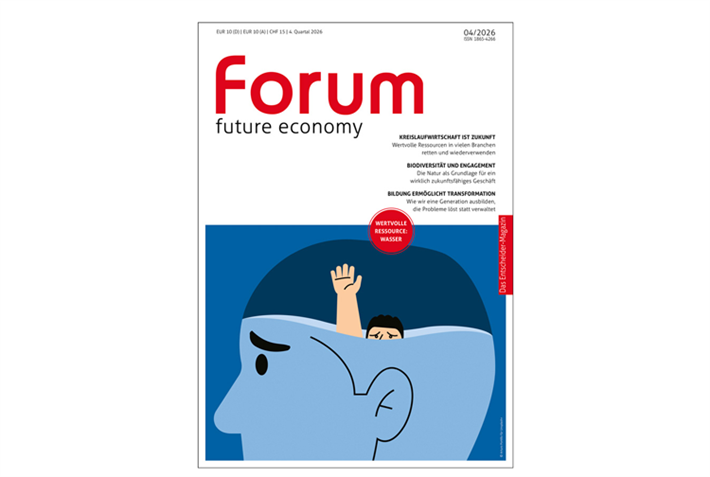
Die Natur lebt vom Kreislauf – und wir?
forum 04/2026
- Kreislaufwirtschaft
- Biodiversität
- Bildung
- Wasserweisheiten
- Altöl im Kreislauf
Kaufen...
Abonnieren...
12
SEP
2026
SEP
2026
22
SEP
2026
SEP
2026
23
NOV
2026
NOV
2026
Energie- & Umweltgipfel 2026: Produzierende Industrie
Where Industrial Transformation Creates Competitive Advantage
10623 Berlin
Where Industrial Transformation Creates Competitive Advantage
10623 Berlin

Anzeige

Der Mittelstand im ESG-Dschungel. Sie müssen nicht alles machen. Sie müssen nur wissen, was.
Sie erhalten einen klaren Fahrplan: was jetzt zu tun ist, was Sie auf dem Schirm behalten sollten und was Sie getrost ignorieren können.
Digitalisierung
 Sind wir auf dem Weg, uns selbst abzuschaffen?
Christoph Quarch überlegt, was KI-Systeme mit uns machen und wie wir uns verhalten sollten

Jetzt auf forum:
Ein Wochenende voller Musik, Kunst und Begegnung
EthioTrees ist das Leuchtturm-Projekt 2026