Johanna Schwarz
Umwelt | Wasser & Boden, 08.03.2026
No Healthy Soil, no Future
Praveena Sridhar, Chief Science and Technical Officer of Save Soil, on Regenerative Farming and the Path to 2050
Soil is not just another resource – it is the foundation of life on Earth. Yet erosion, misguided subsidies, and short-term agricultural systems are putting this living ecosystem at risk. In this interview, Praveena Sridhar explains why regenerative agriculture is economically viable, what role livestock truly plays in soil health, and how companies and governments can send the right signals today to make healthy soils the global standard by 2050.
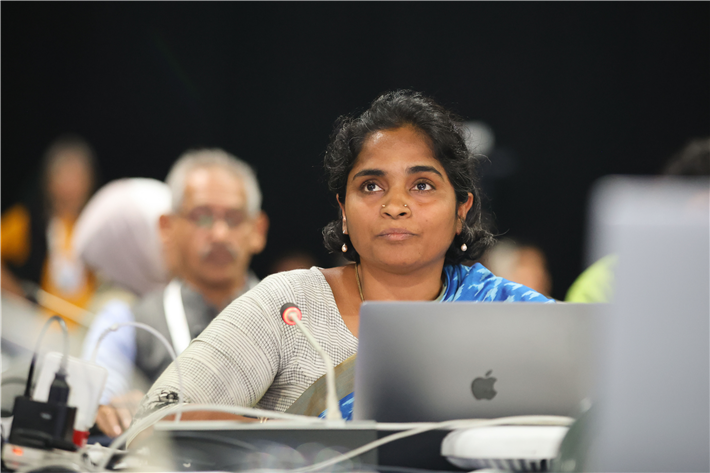
Praveena, why is soil such an important topic, why do you want to save it?
Soil is the very foundation of life on Earth. It provides the nutrients and support for plants to grow, which in turn feed us and all other living creatures. This precious resource takes centuries to form, making it effectively non-renewable within human timescales. Losing soil to erosion, pollution, and unsustainable farming practices means losing the capacity to sustain life as we know it. We must protect this vital resource for generations to come.
Save soil demands higher funding for farmers that use regenerative methods – however, funding can create depenency issues and may not generate sufficient financial returns. What is your solution for that?
Save Soil is asking to incentivise farmers to adopt regenerator practices. This incentive is towards helping them buy new equipment, buy new seeds and acquire new knowledge to adopt a practice that will help them move towards regenerative agriculture. This is required because farmers are the stakeholders who have very little financial bandwidth. This funding that is required to farmers is not charity but investment in the future of humanity because, if 70% of the land which is now held by farmers is managed in a sustainable manner, then you know the ripple effects or the benefits, both direct and indirect, are available for the whole world.
How could farmers that use conventional methods be convinced to work with organic and regenerative methods instead, if the conventional methods are more lucrative for them?
The conventional methods of farming right now are actually not lucrative. They only seem lucrative because there are artificial subsidies by government programs where fertilisers are made available to farmers at a lower price than the actual cost of fertilisers to procure certain grains at a set price. Compared to other methods which may be regenerative and better for the land, the profitability or the safety in conventional farming is because of the existing ecosystem in which farming is operating. Therefore, if the government would actually start to financially incentivise good behaviour towards soil and land by providing access to natural input subsidies; by introducing farmer insurances for people who are adopting soil management practices that actually reduce the risk of crop failures in terms of climate shocks, be it drought or flood, will lead to a behaviour change of farmers because the government is changing the ecosystem to support such behaviour.
What do you think about cutting down the production and consumption of animal products? Wouldn’t that also help to save soils? Or are animals (dung) essential for healthy soils?
There are statistics about how much land is required to be under agriculture if people are consuming animal based products versus plant based products. When people consume plant based products, the land and agriculture needed is almost 50% or less than the total land and agriculture today. But expecting people to change their food habits overnight is not going to be a solution. In certain cultures like India and other parts of the world where the food consumption is not heavily animal meat based consumption, animals are almost seen as god-like because animal dung brings back to the soil the nutrition that is withdrawn out of the land. While dung brings back the micro cultures which support in building life into the land, it also adds the organic matter and nutrients lost due to the harvest of crops. Value addition from dung to the land is not really quantified as much as what animal meat or milk brings to human beings. This way animal dung is far more important in sustaining nutrition for the generations to come. The cows and bulls have a very strong role to play in ensuring our lands and soils are maintained sustainably and are kept alive for future generations to come. And today’s regenerative agriculture practices bring together both traditional and new age technologies to have effective use of animal dung and animal dung based products.
Organic farming takes up more land than the conventional one. As fertile land is becoming less and human kind more – is it (theoretically) possible to feed the world with organic farming methods?
That organic farming takes more land to produce the same amount of food compared to conventional farming is an outdated thought because the present form of agriculture practice is an amalgamation of traditional knowledge and new technology which enhances the outcomes of the land. From what we observe from farmers who we train and move towards regenerative agriculture, if they follow all the things that we teach them from the get go there is no loss. If anything, yields only go upward. Let’s say they’re not able to follow all the instructions that we provided to them, the yield actually starts to turn around from the third year and by the fifth year, the yield in turn is usually greater than with conventional practices.
What can companies in Germany and Europe contribute to healthy soils?
Companies that procure food like the dairy companies or the companies that supply vegetables, food grains, and all - what they could do is give a certain amount or premium to the farmer who has adopted regenerative practices. The premium is towards products that come from land that are maintained in a sustainable way. This is a very strong signal on how the production practice should happen to a farmer as well as to the governments and policies that can incentivise farmers further. The mechanism is always the market and when companies provide this signal that we welcome it to acquire products that are produced regeneratively, suddenly the behaviour changes among farmers which may actually lead to a transition quicker than even the policy based transition.
Also, one more thing is that, if companies directly or indirectly work with food and farmers across the supply chain that move towards regenerative practices, it actually leads to improved carbon sequestration by soil and land - improving the company’s reputation in the consumer's eye. Therefore, reducing the carbon emission along the entire production chain also puts companies in a better position in terms of how they are seen regarding their responsibility towards society by supporting farmers to do the right thing for the land.
What is your vision for 2050?
For Save Soil, as a movement we are keen to push and support governments in adopting policies that facilitate farmers in adopting practices that will support soil life and health by 2050. We would want all the countries to adopt sustainable soil management practices. We want at least 50 to 80% of the farmers of the world to have moved towards regenerative practices which actually regenerates soil health.
That is a goal we love to support you in! Thank you for your answers!
Praveena Sridhar is the chief science and technology officer of the Save Soil movement. She has a master's in Environment Engineering and is a public policy expert. She has been working in the environmental sector for over 15 years. Over the years, she has worked on projects to deliver sustainable drinking water and sanitation, agriculture, and farmer welfare.
Weitere Artikel von Johanna Schwarz:
Sonderausgabe Zirkuläres Bauen
Wege zur zirkulären Bauwirtschaft
Die Sonderausgabe „forum future construction – Wege zur zirkulären Bauwirtschaft“ bringt zentrale Akteure aus Bauwirtschaft, Immobilien, Industrie, Planung, Forschung und Innovation zusammen und zeigt anhand konkreter Praxisbeispiele, Strategien und Projekte, wie Circular Construction Realität wird.
Wege zur zirkulären Bauwirtschaft
Die Sonderausgabe „forum future construction – Wege zur zirkulären Bauwirtschaft“ bringt zentrale Akteure aus Bauwirtschaft, Immobilien, Industrie, Planung, Forschung und Innovation zusammen und zeigt anhand konkreter Praxisbeispiele, Strategien und Projekte, wie Circular Construction Realität wird.
Biodiversität und die Logik der Kreisläufe
Funktionierende Ökosysteme als das beste Vorbild für eine zukunftsfähige Wirtschaft
Zum heutigen Earth Day wird deutlich: Nachhaltigkeit entsteht nicht durch Effizienz allein, sondern durch funktionierende Kreisläufe – in der Natur wie in der Wirtschaft.
Funktionierende Ökosysteme als das beste Vorbild für eine zukunftsfähige Wirtschaft
Zum heutigen Earth Day wird deutlich: Nachhaltigkeit entsteht nicht durch Effizienz allein, sondern durch funktionierende Kreisläufe – in der Natur wie in der Wirtschaft.
Das neue „Recht auf Reparatur“
Ein wichtiger Schritt in Richtung Kreislaufwirtschaft und Resilienz
Reparieren statt Wegwerfen ist nun endlich auch gesetzlich verankert. Ein Kreislauf-orientiertes Wirtschaften wird damit nicht nur zur Pflicht für Unternehmen, sondern auch immer mehr zur strategischen und wirtschaftlichen Notwendigkeit. Der aktuelle Kommentar von forum-Redakteurin Johanna Schwarz.
Ein wichtiger Schritt in Richtung Kreislaufwirtschaft und Resilienz
Reparieren statt Wegwerfen ist nun endlich auch gesetzlich verankert. Ein Kreislauf-orientiertes Wirtschaften wird damit nicht nur zur Pflicht für Unternehmen, sondern auch immer mehr zur strategischen und wirtschaftlichen Notwendigkeit. Der aktuelle Kommentar von forum-Redakteurin Johanna Schwarz.
Grüne Hoffnung, graue Realität?
Rohstoffgerechtigkeit – Schlüssel für eine faire Transformation
Lithium aus Simbabwe, Kobalt aus dem Kongo, Nickel aus Indonesien – die Energiewende hängt von Rohstoffen ab, deren Abbau häufig Menschenrechte verletzt und Lebensräume zerstört. Es braucht eine Transformation, die nicht auf Kosten anderer geschieht, sondern globale Verantwortung, faire Teilhabe und nachhaltige Wertschöpfung verbindet.
Rohstoffgerechtigkeit – Schlüssel für eine faire Transformation
Lithium aus Simbabwe, Kobalt aus dem Kongo, Nickel aus Indonesien – die Energiewende hängt von Rohstoffen ab, deren Abbau häufig Menschenrechte verletzt und Lebensräume zerstört. Es braucht eine Transformation, die nicht auf Kosten anderer geschieht, sondern globale Verantwortung, faire Teilhabe und nachhaltige Wertschöpfung verbindet.
Grüner Kolonialismus?
Über globale Gerechtigkeit und die Energiewende
Miriam Lang lebt seit zwanzig Jahren in Ecuador und brachte im Juni das Buch „Grüner Kolonialismus“ heraus. Im Interview mit forum erzählt sie, wie ihr Leben in Ecuador zu diesem Buch beigetragen hat und wieso die Energiewende auch einen „sozialen und ökologischen Schatten“ hat.
Über globale Gerechtigkeit und die Energiewende
Miriam Lang lebt seit zwanzig Jahren in Ecuador und brachte im Juni das Buch „Grüner Kolonialismus“ heraus. Im Interview mit forum erzählt sie, wie ihr Leben in Ecuador zu diesem Buch beigetragen hat und wieso die Energiewende auch einen „sozialen und ökologischen Schatten“ hat.


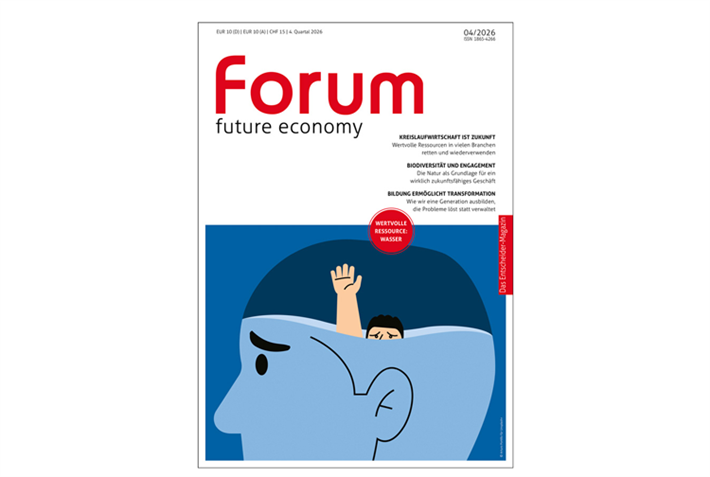
Die Natur lebt vom Kreislauf – und wir?
forum 04/2026
- Kreislaufwirtschaft
- Biodiversität
- Bildung
- Wasserweisheiten
- Altöl im Kreislauf
Kaufen...
Abonnieren...
12
SEP
2026
SEP
2026
22
SEP
2026
SEP
2026
23
NOV
2026
NOV
2026
Energie- & Umweltgipfel 2026: Produzierende Industrie
Where Industrial Transformation Creates Competitive Advantage
10623 Berlin
Where Industrial Transformation Creates Competitive Advantage
10623 Berlin

Anzeige

Der Mittelstand im ESG-Dschungel. Sie müssen nicht alles machen. Sie müssen nur wissen, was.
Sie erhalten einen klaren Fahrplan: was jetzt zu tun ist, was Sie auf dem Schirm behalten sollten und was Sie getrost ignorieren können.
Pioniere & Visionen
 By the dawn's early light
Christoph Quarchs Überlegungen zum 250. Jahrestag der Unterzeichnung der Unabhängigkeitserklärung der Vereinigten Staaten von Amerika
Jetzt auf forum:
Ein Wochenende voller Musik, Kunst und Begegnung
EthioTrees ist das Leuchtturm-Projekt 2026