Umwelt | Ressourcen, 20.10.2025
How to build a successful ecosystem
595,000 employees in 32 countries on their way to Net Zero by 2050
As one of the world's leading retail, production and recycling groups, the companies of Schwarz Group claim to be aware of their responsibility in many fields: from climate protection to circular economy, from food waste to social responsibility, from energy consumption to transparency. forum asked Florian Schütze to share goals and lessons learned with our readers on his on the way to Net zero by 2050.
Mr. Schütze, sustainability has become an integral part of the external image of many companies. How do you ensure that it is not just marketing for the companies of Schwarz Group?
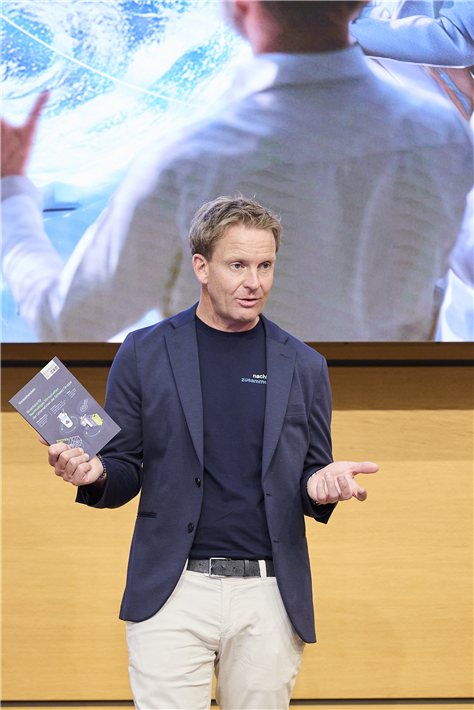
Sustainability has always been part of our DNA. We firmly believe that ecological and economic actions must always go hand-in-hand. We naturally integrate sustainability into our business processes and derive economic benefits from sustainable decisions. For example, we don’t supply our stores with half-empty trucks, because it wouldn’t be economic or ecological.
Driving actively resource conservation, partnerships, efficiency, and digitalization make us more independent and resilient, especially in times of crises and in the face of global conflicts. That's why we invest in sustainable technologies like circular economy and renewable energies sources, promote in-house innovation, and consider future generations in everything we do. We call this "acting ahead”.
Our integrated ecosystem across all companies of Schwarz Group is our decisive advantage: production, retail, recycling, recyclables management, and digitalization are purposefully interlinked. Lidl and Kaufland are retail divisions; Schwarz Produktion is a producer; PreZero is an environmental and recycling service provider; and Schwarz Digits is an IT and digital division. They all work closely together. As one of the world's largest retail groups, we have the opportunity and duty to lead the way. Our approach regarding sustainability is to prioritize transparency over mere promises. We showcase our achievements and potential areas for improvement.
We use over 1,000 sustainability key figures to optimize our business processes and we publish them in our jointly created sustainability report. Our ongoing professional and transparent sustainability management is certified by annual ESG assessments from external service providers and auditors. Software programs used throughout the group make our commitment measurable and traceable. This allows us to analyze developments in a targeted manner, identify areas for improvement, and manage our sustainability goals effectively.
You talk about resource sovereignty and circular economy. What specific milestones and evidences can attest that your targets will be achieved?
The circular economy and its associated targets have been at the heart of our joint sustainability efforts for a long time. Back in 2018, we announced our jointly developed REset Plastic strategy, which included three ambitious targets relating to reducing plastic, using recyclates, and increasing recyclability. The EU did not adopt rules for the use of recycled plastics in food packaging until 2022 — four years after we had launched our plastic strategy.
The results: since 2017, we have reduced the amount of plastic used in our own-brand packaging and transport aids by 34 %. With regards to the use of recyclates, the situation is more complex. Nonetheless, we managed to increase the proportion of recyclates in our own-brand primary plastic packaging to currently 19.7 % for the financial year 2024, and we intent to increase this proportion even further.
In 2025, we launched our new, expanded circular economy strategy REset Resources. REset Resources is the holistic evolution of REset Plastic and covers not only plastic but all material flows, our product and packaging portfolio, and all value creation processes within the companies of Schwarz Group with smart goals.
These range from the design of products and our private-label packaging to logistics and material recycling. With our REset Resources strategy we are setting new standards for European resource sovereignty by keeping resources in circulation, thereby reducing our dependence on supply bottlenecks. We are aligning our actions with ambitious targets and delivering verifiable results. For example: In the 2024 financial year, we were able to return 3.1 million tons of materials to the cycle.
Your "REset Resources" strategy builds on the previous plastics strategy. Looking back, what didn't work and what did you have to learn from this for the new strategy?
Our new jointly developed REset Resources strategy is a holistic approach to the circular economy and a consistent and further development of REset Plastic. We have developed REset Resources to encompass all key areas of a functioning circular economy. Due to the expansion to include all materials and packaging, we have also revised our objectives. We have set measurable goals divided into five fields of action: REdesign, REduce, REuse, REcollect, and REcycle.
There were a couple of learnings we had regarding REset Plastic. For example: In fiscal year 2024, the recycled content in our private-label primary plastic packaging increased to 19.7 % compared to the 2017 baseline. We are working hard to increase this share even further. Thanks to the well-functioning single-use deposit systems and different legal requirements for non-food packaging, we could achieve higher recycled material usage rates in packaging for beverages, detergents, and cleaning products—without neglecting the strict requirements for consumer and product protection. But the situation is different for contact-sensitive food packaging. Achieving our original goal has been more difficult here, as it depends on various external factors, including the availability of high-quality recycled materials and the need to guarantee product safety. Reasons are the lack of suitable recycled materials and strict legal regulations regarding product safety and consumer protection.
REset Resources and the associated expansion to all packaging and materials have made the revision of our goals necessary. Our new REcycle target is to use 65 % recycled content in all our own packaging and 30 % recycled content in our private-label primary plastic packaging by 2030. This further development of our strategy takes the complexity of our entire packaging portfolio into account. These goals are ambitious, considering the economic and political limitations described previously.
With the new Empowering Costumers for the Green Transition Directive, the EU will introduce stricter rules for sustainability claims in the future. How are you preparing for this - and how do you deal with the greenwashing accusations that large retail groups repeatedly face?
We welcome clear rules for environmental statements that establish consistent and reliable level playing field for the European Market. Our commitment to sustainability has always been based on sound decisions and actions that are transparent, understood and measured.
This commitment is complemented by credible communication that uses proof points and considers all stakeholder groups. In order to prevent potential accusations of greenwashing in the context of our climate strategy, we are using science-based targets as our guiding principles, we review our measures on a regular basis, and most importantly, we are transparent. For instance, in February 2025, the Science Based Targets initiative (SBTi) reviewed and validated our short-term, updated climate targets. This independent validation proves that we are on the right track.
PreZero is a central unit in your model. At the same time, the waste disposal industry is regularly criticized for the fact that many recyclable materials end up being incinerated. How transparently can you track and disclose figures and success rates here?
Our environmental service provider, PreZero, promotes a functioning circular economy through its recycling management, ensuring a clean future. PreZero plays an important role in our unique Schwarz Group ecosystem by integrating recycling sites from production to waste management.
We can transparently disclose our figures: In the 2024 fiscal year, 88.6 % of all waste from the companies of Schwarz Group was recycled, reused, fermented, composted, or used as animal feed. Any waste that cannot be recycled is usually thermally recovered in waste-to-energy plants. PreZero is also working on innovative projects, such as producing methane gas from biogas and utilizing food waste with Black Soldier Fly Larvae. This project is especially exciting: PreZero uses this sophisticated recovery process to reduce food waste. The larvae of the black soldier fly upcycle organic waste. As such, valuable proteins can be reintroduced back into the nutrient cycle.
In addition to ecological goals, you mention social responsibility. in your sustainability report. How do you deal with criticism that working conditions at discounters have not always been perceived as "fair" in the past?
We put people at the heart of what we do. Especially since we have the responsibility for approx. 595,000 employees in 32 countries across the companies of Schwarz Group – not only in the retail sector, but as well in production, in recycling, in IT and in many other fields. All of them are aligned with a shared DNA, and in values. Trust, down-to-earthness, performance, respect, and solidarity are our shared values, and we attach great importance to them. We continuously invest in attractive working conditions because qualified and motivated teams are key to our sustainable growth.
This includes fair and competitive pay — nearly 70 % of our employees in Germany are paid according to a collective agreement — as well as work-life balance through flexible work schedules, company daycare, and comprehensive health management programs. Through continuous training and further education, we provide a lifelong learning experience. Our strategy is successful. In the 2024 fiscal year, we created 20,000 new jobs. However, our social responsibility extends far beyond our employees. We require all business partners to adhere to strict human rights standards through our company-wide Code of Conduct.
Net-Zero by 2050 sounds ambitious - but at the same time relatively far in the future. Which short-term measures are a priority for you, and which areas of emissions are still unresolved today?
As one of the world's leading retail groups, the companies of Schwarz Group are aware of their responsibility for climate protection. We joined the Science Based Targets initiative (SBTi) back in 2020. In September 2024, we took the next logical step, and jointly submitted an official Net-Zero Commitment to the SBTi, and committed ourselves to reducing all greenhouse gas emissions to net-zero by 2050. Our roadmap for achieving net-zero is long-term, but of course it requires immediate action and effective measures that are based on science-based targets. The increase in our own electricity consumption from renewable energies, particularly photovoltaics, plays a key role: in the 2024 financial year, we generated around 370,000 megawatt hours of electricity ourselves.
Our biggest challenge on the road to net-zero remains our indirect emissions (Scope 3), which arise in our upstream and downstream value chain and thus are our greatest lever for measurable impact. Because the emissions in Sco pe 3 are not generated by us, we often can’t influence them directly. There are no common standards or specific data about actual emissions from the supply chain either. So we currently must work with statistical averages for emission factors — the so-called secondary data. Trusting partnerships are the strategic lever for the successful implementation of our reduction measures. We are working closely with our suppliers and supporting them, for example, by providing training to help them define their own science-based climate targets and carry out CO2 assessments.
Nonetheless we take actions, for example, by relying on plant-based nutrition: In particular, animal products are a significant cause of high greenhouse gas emissions. In order to reduce these, the retail divisions are continually shaping their product ranges to be more climate-friendly and are offering an increasing number of plant-based alternative products. In 2023, our retail division aligned the prices of virtually the entire range of Vemondo private-label vegan alternatives in Germany to those of comparable non-vegan products. As a result, the majority of Vemondo products are available at the same basic price as their animal-product counterparts.
Your PV figures are impressive, but they probably only account for a small percentage of the group's total energy consumption. What other levers do you see to make your energy supply sustainable?
The use of renewable energies is an important lever to step up climate protection. In principle, as little energy as possible should be used, and when it is, it should be used as efficiently as possible. For this reason, energy efficiency plays a major role in all our business processes. Furthermore, we rely on long-term investments and innovations to secure our energy supply. Almost 100 percent of the electricity purchased by the companies of Schwarz Group comes from renewable sources.
Generating our own energy through photovoltaic systems is a key component of our strategy, but it is only one part. PreZero also generates renewable energy through recycling plants. By systematically expanding our in-house generation of renewable energy, we are reducing our dependence on external energy sources and ensuring our resilience in times of global instability.
Another important element of our energy sovereignty is securing our future energy requirements through long-term contracts. For example, our Power Purchase Agreement (PPA) with RWE will secure around 250,000 MWh of green electricity from an offshore wind farm for Lidl and Kaufland in Germany every year starting in 2028.
How high are the emissions in mobility, transport and logistics and what measures are planned and, above all, have already been taken?
The transportation and logistics sector is a significant source of emissions throughout our supply chain. Therefore, climate-friendly mobility and logistics concepts are another focus of our climate strategy. Together with our partners, we have taken various measures to address this challenge. One important step is digitizing the logistics network to streamline processes, such as optimizing transport capacity utilization.
We are also focusing on using alternative drive systems. At the end of 2023, Kaufland opened a charging park for electric trucks in Germany. Lidl already has well over 60 battery-powered electric trucks in use for store deliveries in 17 countries. Additionally, we are focusing on consistently expanding the charging infrastructure at the companies of Schwarz Group locations, as well as offering sustainable mobility services to employees.
Sustainability is often described as a "business case". Are there situations in which ecological goals collide with economic interests - and what scope for decision-making do you have here?
At the companies of Schwarz Group, we do view sustainability as a "business case", but there’s more to it. We implement concrete measures to demonstrate that sustainable management and long-term economic success are interconnected. Rather than backing away from our ambitious goals during uncertain times, we forge ahead with our plans and act with foresight.
An example: We increase energy efficiency and reduce carbon emissions by using the waste heat from refrigeration systems in the energy concepts of the stores. At Lidl and Kaufland, the wasted heat from chiller equipment and refrigeration systems is used to heating the building, up to a certain extent, thus reducing additional energy consumption from external sources. This solution is not only sustainable but also economical.
Furthermore, our investments in sustainable technologies, in-house innovations, and renewable energies make us more resilient and independent, especially in the face of global conflicts. Thanks to our unique ecosystem, we are securing our own foundation and positioning ourselves for a resilient future by covering the entire value chain, from production and retail to waste and recycling management. This allows us to develop tangible solutions that deliver traceable, measurable success.
We acknowledge that sustainable decisions may initially require higher investments. However, we are convinced that these investments will contribute to our company's future. They secure our access to resources, foster trust among our customers, and strengthen our market position in the long term. Therefore, focusing on sustainable solutions has always been an economic- and a strategic decision for us.
Your Group continues to grow strongly. Is it possible to reconcile a steady growth model with genuine resource conservation, or are you coming up against systemic limits here?
We firmly believe that growth and resource conservation are not mutually exclusive; rather, they depend on each other. Our unique ecosystem, extending from production to retail and recycling, enables us to create systemic solutions that facilitate this balancing act.
Our new, holistic circular economy strategy, REset Resources, is a leading example of this. Through that we are promoting resource conservation at all levels. The circular economy allows us to combine ecological responsibility with economic foresight. Our success in the 2024 financial year is clear evidence of this. With almost 33 % less plastic in Lidl and Kaufland's primary plastic packaging and transport aids, we exceeded our 2025’s reduction target.
Additionally, we reduced the use of new plastic by nearly 65,000 tons, by using recycled material in our recycled bottles. We also save considerable amounts of primary materials by using recycled products in new construction projects, such as 489 tons of virgin plastic using recycled impact protection elements and 348 tons through roofing membranes made from recycled plastic films. Despite our growth model, we are making measurable progress in conserving resources.
What system developments are you making here together with suppliers, competitors and partners along the entire value chain?
We believe that strong and trusting partnerships along the entire value chain are the strategic lever for successful change. To achieve our ambitious goals, we rely on joint system developments within and beyond the companies of Schwarz Group. Our unique ecosystem enables us to develop innovative and sustainable solutions holistically and integrate them across all business units. Once a solution works for us, we can also offer it to third parties. This is how we achieve scale and growth.
We rely on close cooperation with our suppliers, especially for our climate strategy. As one of the world's largest retail groups, we take our responsibility seriously and actively support our partners on the path to net-zero. To achieve our joint Scope 3 target and reduce emissions along the supply chain, we have joined the Supplier Leadership on Climate Transition (Supplier LOCT) initiative. This program enables suppliers worldwide to set their own climate targets, develop action plans, and facilitate climate reporting.
Thus, LOCT starts where most emissions occur in a retail group: in the value chain. Collaborating is essential to collectively taking a significant step towards achieving net-zero emissions.
How independently do external bodies audit your sustainability strategy? Are there reliable audits that confirm the effectiveness of your measures?
External audits are a key component for us because they help us demonstrate the credibility of our joint sustainability efforts. We rely on partners and independent audits to confirm the impact of our measures.
For instance, independent auditors, such as EY in the last financial year of 2024, audit the key figures in our jointly created sustainability report. The check mark on our key figures, shows us that our commitment is based on valid, quality-assured figures of meaningful significance. In our strategic focus on joint sustainability efforts, we also rely on partnerships with well-established institutions, such as the Science Based Targets Initiative (SBTi) for our climate targets or the Ellen MacArthur Foundation (EMF) for the circular economy. We report our progress in achieving our packaging targets to the EMF every year.
We have also been a member of the UN Global Compact since 2020 and conducting an annual ESG rating with Sustainalytics since 2022. This involves an independent assessment of all potential sustainability risks and the corresponding risk management. In May 2024, the companies of Schwarz Group received a rating of 20.3 in the food retail category. This result clearly demonstrates that we are working on further improvements in the areas of environment, social and governance. Thus, we know that our sustainability efforts are sound, and external experts agree. And we treasure it, since we want to be drivers of real change.
Mr. Schütze, thank you for the interview and, above all, for your openness.
Florian Schütze is Member of the Executive Board of Schwarz Corporate Affairs and in charge of Corporate Responsibility.


Die Natur lebt vom Kreislauf – und wir?
forum 04/2026
- Kreislaufwirtschaft
- Biodiversität
- Bildung
- Wasserweisheiten
- Altöl im Kreislauf
Kaufen...
Abonnieren...
23
NOV
2026
NOV
2026
Energie- & Umweltgipfel 2026: Produzierende Industrie
Where Industrial Transformation Creates Competitive Advantage
10623 Berlin
Where Industrial Transformation Creates Competitive Advantage
10623 Berlin
23
NOV
2026
NOV
2026
European Sustainability Week
Built on Trust. Driven by Insight. Focused on Impact. - Ticketrabatt für forum-Leser*innen
53639 Königswinter
Built on Trust. Driven by Insight. Focused on Impact. - Ticketrabatt für forum-Leser*innen
53639 Königswinter

Anzeige
Der Mittelstand im ESG-Dschungel. Sie müssen nicht alles machen. Sie müssen nur wissen, was.
Sie erhalten einen klaren Fahrplan: was jetzt zu tun ist, was Sie auf dem Schirm behalten sollten und was Sie getrost ignorieren können.

Jetzt auf forum:
Alle sind aufgerufen, einen Atomkrieg zu verhindern
BN-Donauschifffahrt zeigt den Wert der frei fließenden Donau auf
Konkrete Gefahren für Betriebe
Ein Wochenende voller Musik, Kunst und Begegnung
EthioTrees ist das Leuchtturm-Projekt 2026