Umwelt | Wasser & Boden, 25.04.2026
G7 declaration recognizes land degradation and drought as global security risks
Ministers urge stronger action on land restoration, drought resilience and investment
Ministers urge stronger action on land restoration, drought resilience and investment. UNCCD Executive Secretary calls for increased investment to translate commitments into action.
 Ministers at the Group of Seven (G7) Environment Ministerial meeting, held in Paris from 23 to 24 April, formally recognized desertification, land degradation and drought as systemic global challenges and security risk multipliers, committing to strengthen action on land restoration, drought resilience and sustainable land management.
 These interlinked crises are already affecting ecosystems, livelihoods and food and water security, with growing implications for economic stability and peace, particularly in fragile and conflict-affected regions.
In their joint declaration, ministers stressed the strategic importance of addressing the land degradation–security nexus, highlighting how environmental pressures are intensifying competition over resources, contributing to displacement and heightening risks of instability.
In the past six decades, over 40 per cent of intrastate conflicts have been linked to disputes over natural resources, particularly land and water, underscoring the growing security implications of land degradation and drought.
Land degradation already affects a significant share of the world’s land—up to 40 per cent—and costs an estimated US$ 900 billion annually, with cascading impacts across food systems, water availability, economies and livelihoods.
Welcoming the declaration, the Executive Secretary of the United Nations Convention to Combat Desertification (UNCCD), Yasmine Fouad, said this political recognition must now translate into action, highlighting the gap between commitments and implementation.
"Land degradation and drought are no longer marginal issues. They are already shaping the daily lives of millions of people, affecting what they can grow, what they can eat and whether they can remain on their land,” Fouad said. "Restoring land is therefore an investment in peace, resilience and long-term stability. What is needed now is to match political attention with the financing and partnerships required to deliver results.”
"We are not facing a knowledge gap. We are facing an implementation gap,” she added. "Countries have already identified their priorities and targets. The challenge now is real progress on the ground.”
This urgency is underscored by the scale of the challenge. An estimated 3.2 billion people already live in areas affected by land degradation, placing increasing pressure on food systems, livelihoods and social stability. Ministers highlighted that investment in land restoration and drought resilience remains insufficient and fragmented, calling for stronger alignment of public and private finance and greater coordination across international financial institutions.
In support of these commitments, the French Presidency announced initiatives such as the Nature & People Finance Alliance, aimed at scaling up public and private investment in nature and ecosystems.
These efforts are anchored in the declaration, which reaffirms the central role of the UNCCD in addressing desertification, land degradation and drought globally, and identifies the 17th session of the Conference of the Parties (COP17) to the UNCCD, to be held in Mongolia in August 2026, as a key opportunity to deliver concrete outcomes.
Looking ahead, Executive Secretary Fouad stressed that COP17 must now deliver tangible progress on land restoration and drought resilience.
"COP17 must be the moment where commitments on land restoration and drought resilience translate into visible progress, particularly in the most vulnerable regions,” she said.
"It is an opportunity to bring land to the center of global economic and security discussions and ensure it is treated as a strategic priority.”
About UNCCD
The United Nations Convention to Combat Desertification (UNCCD) is the global vision and voice for land. We unite governments, scientists, policymakers, private sector and communities around a shared vision and global action to restore and manage the world’s land for the sustainability of humanity and the planet. Much more than an international treaty signed by 197 Parties, UNCCD is a multilateral commitment to mitigating today’s impacts of land degradation and advancing tomorrow’s land stewardship to provide food, water, shelter and economic opportunity to all people in an equitable and inclusive manner.
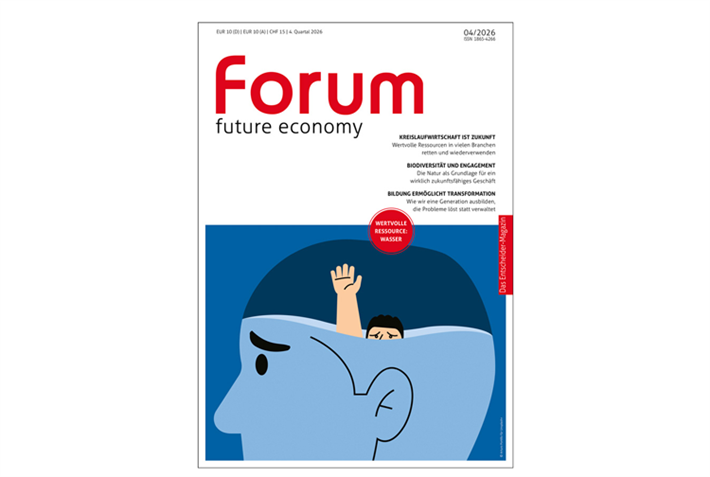
You can finde more solutions for land degradation and drought in the international edition of forum future economy.


Die Natur lebt vom Kreislauf – und wir?
forum 04/2026
- Kreislaufwirtschaft
- Biodiversität
- Bildung
- Wasserweisheiten
- Altöl im Kreislauf
Kaufen...
Abonnieren...
23
NOV
2026
NOV
2026
Energie- & Umweltgipfel 2026: Produzierende Industrie
Where Industrial Transformation Creates Competitive Advantage
10623 Berlin
Where Industrial Transformation Creates Competitive Advantage
10623 Berlin
23
NOV
2026
NOV
2026
European Sustainability Week
Built on Trust. Driven by Insight. Focused on Impact. - Ticketrabatt für forum-Leser*innen
53639 Königswinter
Built on Trust. Driven by Insight. Focused on Impact. - Ticketrabatt für forum-Leser*innen
53639 Königswinter


Anzeige

Der Mittelstand im ESG-Dschungel. Sie müssen nicht alles machen. Sie müssen nur wissen, was.
Sie erhalten einen klaren Fahrplan: was jetzt zu tun ist, was Sie auf dem Schirm behalten sollten und was Sie getrost ignorieren können.
Pioniere & Visionen
 By the dawn's early light
Christoph Quarchs Überlegungen zum 250. Jahrestag der Unterzeichnung der Unabhängigkeitserklärung der Vereinigten Staaten von Amerika

Jetzt auf forum:
Alle sind aufgerufen, einen Atomkrieg zu verhindern
BN-Donauschifffahrt zeigt den Wert der frei fließenden Donau auf
Konkrete Gefahren für Betriebe
Ein Wochenende voller Musik, Kunst und Begegnung
EthioTrees ist das Leuchtturm-Projekt 2026