Daniel Truran
Umwelt | Klima, 14.06.2024
A new direction for COP
Focus and isolation or an interconnected cocreation?
Attending the Bonn Climate Change Conference of the United Nations SB60, gave me a first hand view of a deep debate that is now taking place on the format and mindset of The Conference of the Parties (COP) and the work of UNFCCC. The big theme that was addressed at SB60 , beyond the lack of funding to move this forward, was the role of NGOs and other parties now being part of COPs in ever greater numbers every year.
 Should COPs be closed events, where only negotiators from all the countries of the world come together and focus only on agreeing the climate statement. Or should COPs be open to an interconnected and active interaction between negotiators and the external organizations that are accelerating the sustainable solutions that COPs aim to achieve?
 We are living a critical time for the planet, so shed light on the significance and implications of these events is key to the present and future of our planet.
The Conference of the Parties (COP) takes place at the end of each year. To prepare for the COP, the work is divided into two main streams known as Subsidiary Bodies (SB). There are two permanent SBs: the Subsidiary Body for Scientific and Technological Advice (SBSTA) and the Subsidiary Body for Implementation (SBI). Both are crucial, covering a broad range of topics and challenges that must be addressed, which is exactly what I witnessed at SB60.
However, the agenda is overwhelming. Negotiations include the global stocktake, the global adaptation goal, just transition, mitigation, the new financial goal, response measures, agriculture and food security, loss and damage, carbon markets, and that’s not even the full list. Additionally, there are over 30 mandatory events covering various issues, including the impact of climate change on children, mountains, and the ocean. There are side events, briefing sessions, poster sessions—the list goes on.
The Complex Geopolitical Landscape
It’s important to understand that the challenge of this meeting isn’t just the agenda; it’s also the geopolitical context surrounding the negotiations. There’s a war in Palestine, a war in Sudan, elections in half the world, inflation, and rising living costs. All these factors influence how we interact during these negotiations, and tensions are high.
You might not think these issues are related to climate change, but they are. In fact, that’s the point: we are so interconnected that everything affects everything else. To address one problem, we actually need to get to the root of all of them. And what is that root? Disunity, division, and a lack of recognition of our common humanity.
Negotiations and Solutions at the Heart of SB60
At the SB60 United Nations Climate Conference in Bonn, we have created opportunities, events, and dialogues to showcase the regenerative solutions we are accelerating.
What Have We Learned?
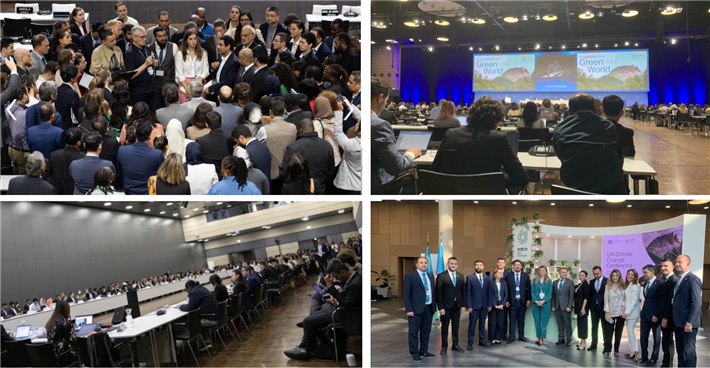
- The Power of Unity this image shows the frantic action of negotiators, people from all corners of the world working together to come to an agreement. In the United Nations halls, there was no polarization but an energy of open interaction. This experience highlighted the concept that "The Earth is one country, and mankind its citizens”. I witnessed and participated in conversations among the most diverse individuals, demonstrating what we can achieve through unity.
- Ending Isolation The SB60 experience, preparing for COP29 this November, showed me the importance of moving away from isolated progress. Negotiators from each nation determine the texts of declarations and documents for the next summit, often isolated from the environment they aim to serve. I felt that progress would be faster with an open mindset to interact and create synergies with entities progressing the solutions we need.
- The Role of a New Generation I was deeply impacted and impressed interacting with twenty-somethings with already years of experience negotiating and advancing issues at the United Nations—a generation that sets no limits, driven by an ambition to co-create solutions from which we can all learn.
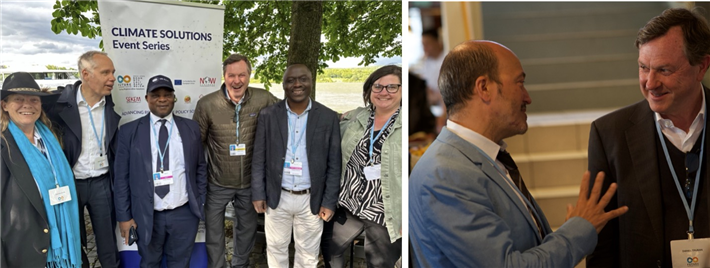
- Heroes Among Us In this photo, on one end on the left is Hunter Lovins, one of the smartest most incisive and impactful activist since COP3, and on the other end, Lucy Wallace, leading EIT Food. These two are just a couple of the heroes, the special people who dedicate their lives to advancing the dialogues, the understanding and the actions that are progressing what we need most: regenerative, replicable solutions, putting humans and planet at the centre of all they do. A special mention goes to Marcos Montoiro from Huesca, Spain, featured in the right hand photo. For 21 years, he has been at the forefront of global actions and conventions fighting desertification, a pressing issue. At the UN Convention to Combat Desertification, he tirelessly co-creates the most relevant opportunities globally for this significant challenge. Moreover, he is an exceptional human being.
Daniel Truran is strategist, impact innovator, speaker, enabler and business schools professor. Leading global and local organizations to implement impact innovation for more than 20 years. He is Director General of the ebbf, co-founder Impact Hub Madrid, B-Corp Ambassador, Business School professor and Academic Director at EOI, IE, ESADE, Comillas, Henley Business School.
Kontakt: Daniel Truran, NOW Partners | daniel@now.partners | now.partners


Die Natur lebt vom Kreislauf – und wir?
forum 04/2026
- Kreislaufwirtschaft
- Biodiversität
- Bildung
- Wasserweisheiten
- Altöl im Kreislauf
Kaufen...
Abonnieren...
12
SEP
2026
SEP
2026
22
SEP
2026
SEP
2026
23
NOV
2026
NOV
2026
Energie- & Umweltgipfel 2026: Produzierende Industrie
Where Industrial Transformation Creates Competitive Advantage
10623 Berlin
Where Industrial Transformation Creates Competitive Advantage
10623 Berlin
Anzeige

Der Mittelstand im ESG-Dschungel. Sie müssen nicht alles machen. Sie müssen nur wissen, was.
Sie erhalten einen klaren Fahrplan: was jetzt zu tun ist, was Sie auf dem Schirm behalten sollten und was Sie getrost ignorieren können.
Digitalisierung
 Sind wir auf dem Weg, uns selbst abzuschaffen?
Christoph Quarch überlegt, was KI-Systeme mit uns machen und wie wir uns verhalten sollten

Jetzt auf forum:
Ein Wochenende voller Musik, Kunst und Begegnung
EthioTrees ist das Leuchtturm-Projekt 2026