Umwelt | Umweltschutz, 15.06.2018
Unprecedented EU-wide mobilization of fishers against electric fishing
#FishersUnited #FishersResist
Small-scale and traditional fishers of various nations are mobilizing in ports in a
simultaneous action of resistance to protest against electric fishing and to call on public
decision-makers to definitively ban electric fishing in the EU.
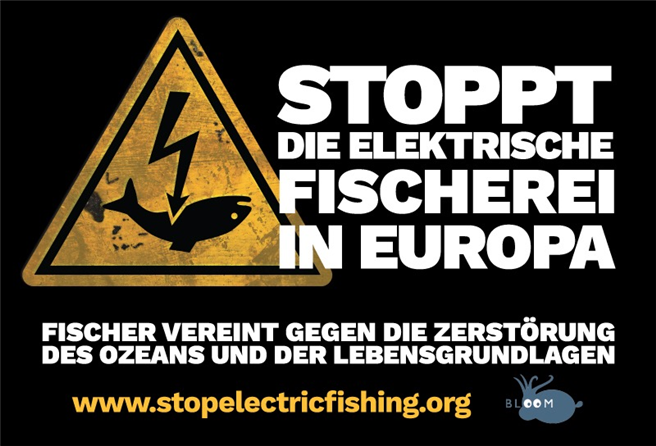 Fishers from Belgium, the Netherlands, France, Germany and the UK have decided to act
with BLOOM and other NGOs to denounce a fishing method which is destroying the marine
environment as surely as it is threatening their very economic survival. They are taking
action at 9 am on Monday 18 June 2018 in the following ports around the North Sea:
IJmuiden (Netherlands), Nieuwpoort (Belgium), Boulogne-sur-Mer (France), Lowestoft (UK).
Other regions are mobilizing too: Flensburg on the Baltic Sea (Germany) and the following
regions in France: Concarneau, Le Guilvinec and Saint Brieuc in Brittany, Saint Mandrier and
La Ciotat on the Mediterranean Coast and Saint Jean de Luz on the Atlantic Coast.
Fishers from Belgium, the Netherlands, France, Germany and the UK have decided to act
with BLOOM and other NGOs to denounce a fishing method which is destroying the marine
environment as surely as it is threatening their very economic survival. They are taking
action at 9 am on Monday 18 June 2018 in the following ports around the North Sea:
IJmuiden (Netherlands), Nieuwpoort (Belgium), Boulogne-sur-Mer (France), Lowestoft (UK).
Other regions are mobilizing too: Flensburg on the Baltic Sea (Germany) and the following
regions in France: Concarneau, Le Guilvinec and Saint Brieuc in Brittany, Saint Mandrier and
La Ciotat on the Mediterranean Coast and Saint Jean de Luz on the Atlantic Coast.Electric fishing was forbidden in Europe in 1998 but the European Commission proposed to
authorize it as of 2006 under an exceptional derogation regime. This decision, which went
against the explicit scientific advice provided to the Commission, is causing far-reaching
chaos: as a result, an entire commercial fleet converted to a prohibited, destructive fishing
method under the guise of experimental and scientific licenses, but by the public admission
of the Dutch government, scientists and fishing industry, such scientific activities were not
conducted. The Dutch government and European Commission have also been mutually guilty
of providing electric licenses well beyond the authorized legal limit.
From a financial point of view, electric fishing has become a symbol of the biased
arbitration of public authorities in favour of an over-represented, politically powerful
fishing lobby. To save the nearly-bankrupt and high-impact beam trawl fleet, politicians
renamed a destructive fishing method (electric fishing) as "innovative”, thus allowing them
not only to practice this prohibited fishing method but to obtain millions of euros of public
subsidies to equip beam trawlers with electrodes at the expense of taxpayers and European
citizens.
This file is a European embarrassment comparable to scientific whaling . It contradicts all
EU commitments to sustainability, breaks EU rules of financial transparency and tramps legal
obligations to ensure equitable access to resources among fishers. Finally, electric fishing
also treads on regulatory objectives of environmental restoration and use of public monies.
The worst part though is that public policies are caught red-handed destroying not just the
marine environment, but employment . And although proven wrong, decision makers and
politicians at EU or national levels persist in defending the worst fishing practices instead ofthe best ones. For example, while electric trawlers discard between 50 to 70%1 of fish
caught,
gillnetters only discard a maximum of 6%.2 Similarly, for one liter of fuel burnt, gillnetters
catch up to 6 times more fish (2 to 3 kilos) than electric trawlers (450 grams).
Despite the obvious socio-economic and ecological merits of coastal fishing methods used by
small-scale and traditional fishers, the most destructive, fuel-intensive and
subsidy-dependent fishers catch the ear of politicians.
In every aspect, electric fishing shames Europe.
Over the years, the depletion of fish along the coastline of the North Sea has brought
traditional fishers to the brink of economic collapse. As an example, between 2014 and
2018, French gillnetters from the North have lost on average 50% of their catch of sole.3
Industrial lobbies, year after year, have gained control over "producer organizations” (which
allocate fishing quotas), political representation bodies, port management structures and
fleet ownerships. Small fishers have been slowly but surely forced to silence because if they
dare speak up against dominant actors, retaliation is immediate and fierce (quotas, fishing
rights, licenses etc.)
Their future is as pitch black as a tunnel with no light at the end . It took reaching that level
of despair and being on the verge of bankruptcy for fishers to denounce the oppression of
industrial actors in their fishing quarters. They are now determined to fight until the end,
until electric fishing is fully and definitively banned.
The coalition of NGOs and fishermen launched a collective platform of action to call on
decision makers.
Kontakt: Wolfgang Albrecht, Fischereischutzverband – Schleswig-Holstein | fischereischutzverband-sh@web.de


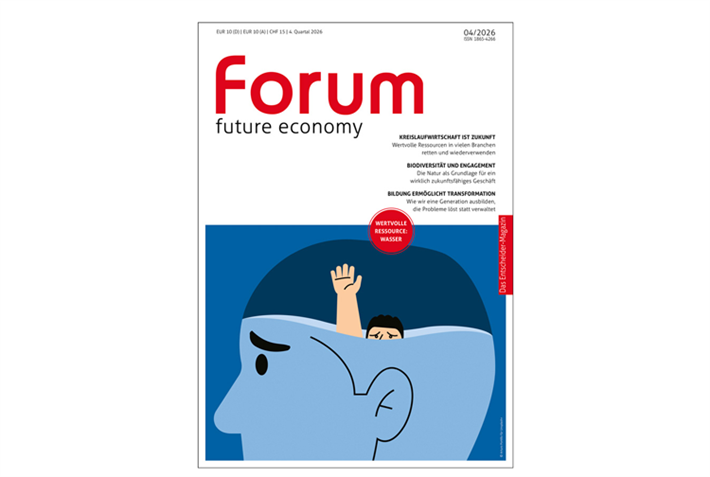
Die Natur lebt vom Kreislauf – und wir?
forum 04/2026
- Kreislaufwirtschaft
- Biodiversität
- Bildung
- Wasserweisheiten
- Altöl im Kreislauf
Kaufen...
Abonnieren...
08
OKT
2026
OKT
2026
forumESGready - Fortsetzung unserer beliebten Online-Events ab 8. Oktober
Transformation im Mittelstand: Aktuelle relevante Themen in drei Terminen
Online
Transformation im Mittelstand: Aktuelle relevante Themen in drei Terminen
Online
20
OKT
2026
OKT
2026
Personalmesse München powered by Zukunft Personal
Die Messe für Recruiting, Personalmanagement, BGM und Weiterbildung
80939 München
Die Messe für Recruiting, Personalmanagement, BGM und Weiterbildung
80939 München
23
NOV
2026
NOV
2026
European Sustainability Week
Built on Trust. Driven by Insight. Focused on Impact. - Ticketrabatt für forum-Leser*innen
53639 Königswinter
Built on Trust. Driven by Insight. Focused on Impact. - Ticketrabatt für forum-Leser*innen
53639 Königswinter


Anzeige

Der Mittelstand im ESG-Dschungel. Sie müssen nicht alles machen. Sie müssen nur wissen, was.
Sie erhalten einen klaren Fahrplan: was jetzt zu tun ist, was Sie auf dem Schirm behalten sollten und was Sie getrost ignorieren können.
Digitalisierung
 Sind wir auf dem Weg, uns selbst abzuschaffen?
Christoph Quarch überlegt, was KI-Systeme mit uns machen und wie wir uns verhalten sollten

Jetzt auf forum:
Januar 2027: Kommt die ESG-Berichtspflicht für den Mittelstand?
MBA Sustainability Management: Live-Podcast und 42 neue Absolvent*innen
Es brennt! Doch kaum regnet es, ist alles vergessen …
Wie smarte Technologie Würde und Sicherheit im Alter sichert
LEEF wird fürs Nachhaltigkeitsmanagement ausgezeichnet
Konkrete Gefahren für Betriebe
Nachhaltigkeit beginnt mit gutem Design
Bereits über 70 Veranstaltungen für Munich Climate Week 2026 angekündigt