Umwelt | Ressourcen, 17.06.2025
Agricultural waste can become the clothes of the future
Cellulose-based textile materials can make the clothing sector more sustainable
Currently, cellulose-based textiles are mainly made from wood, but a study headed by researchers from Chalmers University of Technology in Sweden points to the possibility of using agricultural waste from wheat and oat. The method is easier and requires fewer chemicals than manufacturing forest-based cellulose, and can enhance the value of waste products from agriculture.
 Making clothing from water-intensive cotton has a major impact on the climate. That’s why cellulose from other raw materials has come into focus in recent years as a more resource-smart method of textile production. Up to now, the efforts have concentrated on wood-based cellulose. But in a recently published study, researchers investigated a different path for cellulose fibre manufacture, by using waste products from agriculture, which Sweden has a lot of.
The researchers tested oat husks, wheat straw, potato pulp and sugar beet pulp. Oat husks and wheat straw turned out to work best to develop a pulp, called dissolving pulp, which is used to make clothing.
"With this method, which we further developed in this study, we show that you can make textile pulp from certain agricultural waste products,” says Diana Bernin, Assistant Professor at the Department of Chemistry and Chemical Engineering at Chalmers and senior researcher in the study. "This is an important step towards being able to create textiles from waste products instead of using cotton, which isn’t climate-friendly, or wood, a material that we want to use for so many things while also needing to preserve it for the benefit of the climate.”
More sustainable manufacturing with lye
The team used soda pulping as one part of the process. This means that the raw material is boiled in lye, which makes manufacturing more sustainable.
"Lye doesn’t contain any toxins or substances that impact nature,” she explains. "Soda pulping doesn’t work for wood fibres, so making textile pulp from wheat straw and oat husks requires fewer chemicals than making forest-based cellulose. It’s also a simpler procedure, in part because it doesn’t require processing such as chipping and debarking. In addition, it increases the economic value of oats and wheat, when leftovers from their production can be used as raw materials for cellulose extraction.”
Bernin says it is likely that several other agricultural waste products can be used for textile manufacture using the method her team developed. She is currently involved in an international project that has found, using the method in this study, that press-cake from grass from fields works very well to create dissolving pulp.
In continued studies that have yet to be published, the researchers have also taken another step towards practical application of the dissolving pulps, creating textile fibres based on pulp from wheat and the press-cake from grass.
Hope of using existing industries
In the long run, Bernin sees good opportunities to use the pulp-and-paper industry, which already has technology and processes in place, to make dissolving pulp from agricultural waste.
"If we can make use of our existing industry and adjust their processes instead of building new production facilities, we’ve already come a long way,” she says.
The lead author of the study is Joanna Wojtasz, former postdoc at Chalmers and now a researcher at the innovation company Tree To Textile, which is one of the partners in the project.
"The study shows that there is a lot of potential in agricultural waste,” Wojtasz says. "We really shouldn’t disregard the opportunity to use this type of cellulose streams for our future clothing.”
More about the study:
The study Producing dissolving pulp from agricultural waste was recently published in the scientific journal RSC Sustainability. The study was funded by Bioinnovation and was conducted in collaboration between Chalmers University of Technology, the innovation company Tree To Textile and IVL Swedish Environmental Research Institute at Bioinnovation’s industrial graduate school Resource-Smart Processes.
Chalmers University of Technology in Gothenburg, Sweden, conducts research and education in technology and natural sciences at a high international level. The university has 3100 employees and 10,000 students, and offers education in engineering, science, shipping and architecture.
With scientific excellence as a basis, Chalmers promotes knowledge and technical solutions for a sustainable world. Through global commitment and entrepreneurship, we foster an innovative spirit, in close collaboration with wider society.
Chalmers was founded in 1829 and has the same motto today as it did then: Avancez – forward.
Kontakt: Chalmers University of Technology, Diana Bernin | diana.bernin@chalmers.se | www.chalmers.se


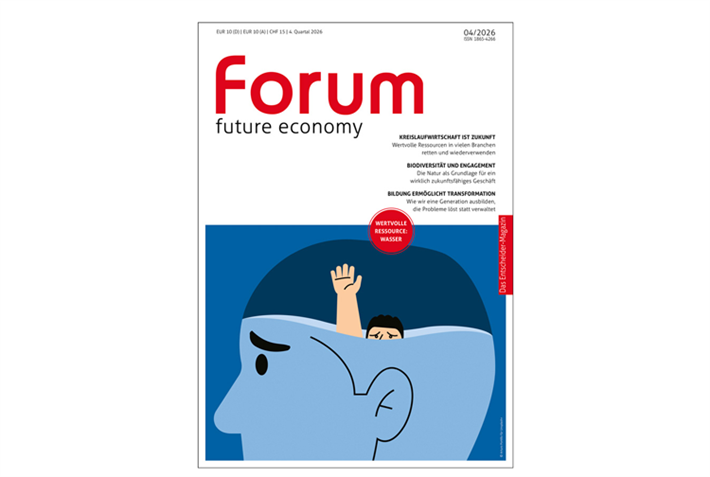
Die Natur lebt vom Kreislauf – und wir?
forum 04/2026
- Kreislaufwirtschaft
- Biodiversität
- Bildung
- Wasserweisheiten
- Altöl im Kreislauf
Kaufen...
Abonnieren...
18
SEP
2026
SEP
2026
Parking Day 2026 in München
Parkplätze werden zu Orten für Menschen, Natur und nachhaltige Mobilität
München
Parkplätze werden zu Orten für Menschen, Natur und nachhaltige Mobilität
München
08
OKT
2026
OKT
2026
forumESGready - Fortsetzung unserer beliebten Online-Events ab 8. Oktober
Transformation im Mittelstand: Aktuelle relevante Themen in drei Terminen
Online
Transformation im Mittelstand: Aktuelle relevante Themen in drei Terminen
Online
23
NOV
2026
NOV
2026
European Sustainability Week
Built on Trust. Driven by Insight. Focused on Impact. - Ticketrabatt für forum-Leser*innen
53639 Königswinter
Built on Trust. Driven by Insight. Focused on Impact. - Ticketrabatt für forum-Leser*innen
53639 Königswinter


Anzeige

Der Mittelstand im ESG-Dschungel. Sie müssen nicht alles machen. Sie müssen nur wissen, was.
Sie erhalten einen klaren Fahrplan: was jetzt zu tun ist, was Sie auf dem Schirm behalten sollten und was Sie getrost ignorieren können.
Pioniere & Visionen
 By the dawn's early light
Christoph Quarchs Überlegungen zum 250. Jahrestag der Unterzeichnung der Unabhängigkeitserklärung der Vereinigten Staaten von Amerika

Jetzt auf forum:
Es brennt! Doch kaum regnet es, ist alles vergessen …
LEEF wird fürs Nachhaltigkeitsmanagement ausgezeichnet
Konkrete Gefahren für Betriebe
Nachhaltigkeit beginnt mit gutem Design
Bereits über 70 Veranstaltungen für Munich Climate Week 2026 angekündigt
Bessere Verpackungen, weniger Müll
Bundespreis Ecodesign: Ausstellung, 19.-22. September & Vernissage, 18. September 2026, Berlin