Technik | Green Building, 11.07.2018
The 22-square-meter Tiny House
Yale School of Architecture and UN Environment unveil Eco Living Module
UN Environment and Yale University — in collaboration with UN-Habitat — unveiled a new eco-housing module to spark public discussion and new ideas on how sustainable design can provide decent, affordable housing while limiting the overuse of natural resources and climate change.
|
Vorschau: In der nächsten Ausgabe von forum Nachhaltig Wirtschaften erfahren Sie mehr zum Thema Tiny Houses (Erscheinungstermin 30.8.2018). |
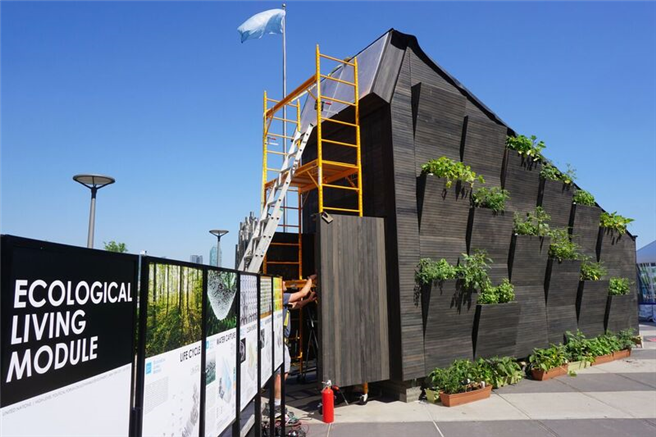
The 22-square-meter "tiny house” is fully powered by renewable energy and designed to test the potential for minimizing the use of natural resources such as water.
The Ecological Living Module, unveiled during the United Nations High-level Political Forum on Sustainable Development, is constructed primarily from locally-sourced, bio-based renewable materials. The first demonstration unit is on view in the UN Plaza in New York City through July 18.
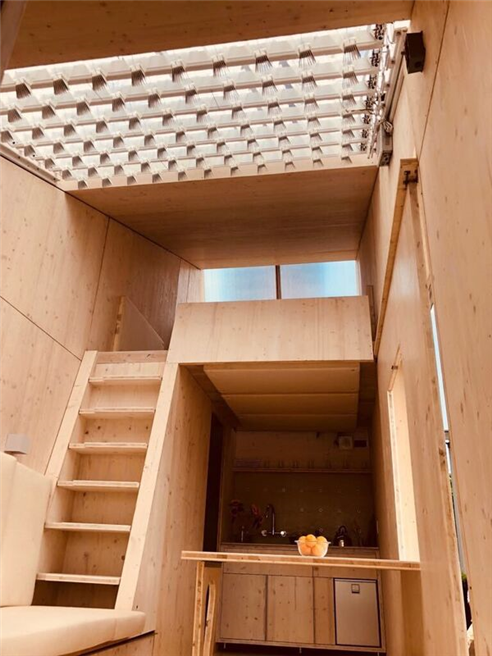
The Yale Center for Ecosystems in Architecture worked with Gray Organschi Architecture to design, fabricate, and install the Ecological Living Module. The unit is efficient and multi-functional, accommodating up to four people, serving both domestic and commercial purposes.
 "We clearly need more housing, but the key thing is that we also need smarter housing” said Erik Solheim, head of UN Environment. "The housing sector uses 40% of the planet’s total resources and represents more than one-third of global greenhouse gas emissions. Making them more efficient will benefit everyone, and it will mean lower bills, too. Innovations like the Ecological Living Module are what we need more of.”
"Adequate housing is at the heart of sustainable urbanization,” said Maimunah Mohd Sharif, executive director of UN-Habitat. "The use of proper building materials, better planning, and improved construction techniques can make energy use in buildings more efficient. If adopted widely, this practice can create jobs and prosperity with lower greenhouse gas emissions.”
Engineered to operate independently, the module’s built-in systems include solar energy generation using less than 1% of toxic semiconductor materials, on-site water collection, micro agricultural infrastructure, natural daylighting, plant-based air purification, passive cross-ventilation, and a range of flexible, adaptable components for living and working.
About 1 billion people worldwide currently live in informal settlements, while millions more live in buildings that are not environmentally friendly, note the officials. Rapid urbanization and economic growth challenge communities to sustainably expand capacity, heightening the need for innovation in building systems and infrastructure, they say.
"Architecture must address the global housing challenge by integrating critically needed scientific and technical advances in energy, water, and material systems while remaining sensitive to the cultural and aesthetic aspirations of different regions,” said Deborah Berke, dean of the Yale School of Architecture.
 The demonstration unit in the UN Plaza contains features relevant to the local climate and context of New York. Future iterations of the module — including one in Kenya, the home of UN Environment — will respond specifically to local climatic and cultural contexts.
UN Environment
UN Environment provides leadership and encourages partnership in caring for the environment by inspiring, informing, and enabling nations and peoples to improve their quality of life without compromising that of future generations. UN Environment works with governments, the private sector, civil society and with other UN entities and international organizations across the world.
Yale Center for Ecosystems in Architecture
The Center for Ecosystems in Architecture (CEA), founded by Anna Dyson, is a multidisciplinary research venture led by the Yale School of Architecture and the Yale School of Forestry & Environmental Studies. Its goal is to develop transformative systems for the built environment. Alongside its partners in the architecture, engineering, and construction (AEC) Industry, CEA seeks to address the complexity of transitioning global construction patterns by bringing together deep expertise of current practices with radically new socio-economic and technical approaches. CEA prioritizes the requirements of living ecosystems towards buildings and cities that support biodiversity with an integrated approach to clean energy, water, air and material life cycles.
Gray Organschi Architecture
Gray Organschi Architecture (GOA) is a multidisciplinary firm that explores the intersection of design and building production. Based in New Haven, Connecticut, GOA has developed an award-winning practice that integrates architectural design, collaborative research, low-impact ecologically-conscious construction techniques, building fabrication, and construction management. GOA’s projects range in scale and scope from the development of hardware, furniture, and building assembly systems to the design of buildings for evolving institutions, private clients, developers, and municipalities. Alan Organschi is on the faculty of the Yale School of Architecture and coordinates the Yale Building Project.
About UN-Habitat
UN-Habitat is the United Nations program working towards a better urban future. Its mission is to promote socially and environmentally sustainable human settlements development and the achievement of adequate shelter for all.


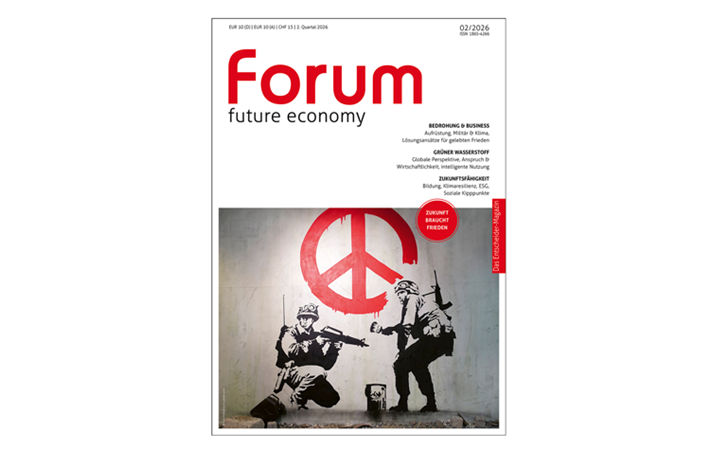
Zukunft braucht Frieden
forum 02/2026 ist erschienen
- Geopolitische Spannungen, Aufrüstung und Unsicherheit prägen Märkte und Investitionsentscheidungen wie lange nicht. Die neue Ausgabe von forum future economy setzt bewusst einen Kontrapunkt: Sie gibt Stimmen Raum, die für Diplomatie, Deeskalation und zivile Lösungen eintreten – weil wirtschaftliche Stabilität ohne Frieden nicht denkbar ist.
Kaufen...
Abonnieren...
05
MÄR
2026
MÄR
2026
10
MÄR
2026
MÄR
2026
Rechtliche Aspekte der Kreislaufwirtschaft
Kreislaufwirtschaft zwischen Green Deal und Praxis
kostenfreies Webinar
Kreislaufwirtschaft zwischen Green Deal und Praxis
kostenfreies Webinar
11
MÄR
2026
MÄR
2026
Circular Valley Convention 2026
Gestalten Sie mit uns die Zukunft der Kreislaufwirtschaft - Ticketrabatt für forum-Leser*innen!
40474 Düsseldorf
Gestalten Sie mit uns die Zukunft der Kreislaufwirtschaft - Ticketrabatt für forum-Leser*innen!
40474 Düsseldorf

Anzeige

Professionelle Klimabilanz, einfach selbst gemacht
Einfache Klimabilanzierung und glaubhafte Nachhaltigkeitskommunikation gemäß GHG-Protocol
Politik
 Das Recht des Stärkeren
Christoph Quarchs philosophische Analyse zum US-Angriff auf Venezuela


Jetzt auf forum:
Gute Politik bedient nicht Partikularinteressen
Zukunft braucht Frieden, Resilienz und Unabhängigkeit
Starke Partnerschaft für den polnischen Offshore-Markt
Mercosur und europäische Verpackungsverordnung: Unterschätzte Falle PPWR
Sozial und ökologisch vor Ort – für lebenswerte Städte und Gemeinden in Bayern